
Close the Workhouse Campaign Gains Momentum
The St. Louis American. April 2019
Close the Workhouse Campaign Gains Momentum Read More »
News Articles
The St. Louis American. April 2019
Close the Workhouse Campaign Gains Momentum Read More »

Review of Tommie Shelby’s Dark Ghettos. Political Theory. 2019
Political Agency In The Face Of Structural Injustice: Is ‘Impure Dissent’ Enough? Read More »
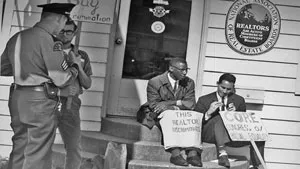
The Common Reader. July, 2018In the spring of 1968, Larman and Geraldine Williams were among the first black homebuyers in Ferguson, Missouri. Larman Williams, a public school principal, worked in the Wellston district, one of just two school districts in St. Louis County with a majority black population. A few years back, the Williams family had
Like Any Other Citizen Would Want: American Residential Segregation Since 1968 Read More »
Abstract: This article engages Rainer Forst’s account of structural power, as elaborated in Normativity and Power: Analyzing Social Orders of Justification. Its central claim is that structural power works, not only through what Forst calls ‘justificatory narratives’, but also through institutionalized and objectified social norms. When norms are institutionalized, they define incentive structures, which people internalize
On Structural Power Read More »

On Lily Geismer, Don’t Blame Us: Suburban Liberals and the Transformation of the the Democratic Party and Timothy Weaver, Blazing the Neoliberal Trail: Urban Political Development in the United States and the United KingdomAt the time of this writing, six months have passed since Donald Trump’s populist grab of what many assumed, going into the 2016 election, was

Abstract: This article brings into conversation two important literatures in contemporary political theory that have, for the most part, failed to engage one another: work spanning more than two decades on multiculturalism and identity politics, and neo-republican work on nondomination. The authors take as their starting-point two widely endorsed claims: that identities are constructs and that
Identity Politics and Democratic Nondomination, Contemporary Political Theory, May 2017 Read More »

Clarissa Rile Hayward is a contemporary political theorist whose work focuses on theories of power, democratic theory, theories of identity, and American urban politics. She is an Associate Professor of Political Science at Washington University and Affiliate Faculty in Washington University’s Department of Philosophy and Programs in American Culture Studies and Urban Studies. She received

Abstract: This essay tackles the thorny question of how to dismantle structural racial injustice.Charles Mills’s work on what Mills calls white epistemologies of ignorance to challenge Young’s emphasis on changing how racially privileged people understand their responsibilities. It makes the case that disruptive politics play a crucial role in dismantling structural injustice. Because they interrupt
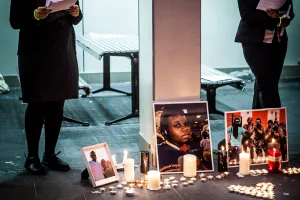
Two years ago today, unarmed black teenager Michael Brown was shot and killed by white police officer Darren Wilson in Ferguson, Missouri. Brown’s death has since become a marker: shorthand for an array of urban and suburban ills, including persistent economic and racial segregation, the racial divide in social and economic opportunities and outcomes, police
The Murder of Michael Brown, co-written with Colin Gordon, Jacobin, August, 2016 Read More »

Hayward crafts a rich and cogent theory of how racial identity is reproduced not merely discursively but materially. Hayward’s book not only enriches renowned accounts of the architecture of American apartheid and the entrenchment of a “possessive investment in whiteness, her nonideal theories of how bad racial stories influence our movement through space and how
User-level and event-level data associated with Google Analytics cookies is retained for 14 months and then automatically deleted.
I have implemented IP Anonymization, simply put, the last three digits of your IP address are set to zeros in memory shortly after being sent to the Analytics Collection Network. The full IP address is never retained, or written to disk.
